

This month, Ebony reopened its archive to mark what would have been André Leon Talley's birthday on October 16, revisiting the brief period in the early 1980s when he served as the magazine's fashion editor. The pages it returned to are more than nostalgia. They are a record of what happens when a Black publication decides that Black designers, Black models and Black readers deserve the same seriousness that luxury fashion reserves for everyone else.
At CHELSEA GRAYS, we read that history closely. The brand was founded in 2018 on the belief that fashion can start conversations, educate and change the way culture sees itself. Talley's year at Ebony is one of the clearest examples of that belief at work, and it carries a particular resonance for a label whose designer, Chelsea Grays, is both an alum of and an educator at North Carolina Central University, the same HBCU where Talley earned his degree.
André Leon Talley at Ebony: A Brief but Defining Chapter
Talley arrived at Ebony after working at Women's Wear Daily and W, where, as Complex recounts, he encountered racism and discrimination. He was invited to Johnson Publishing Company by Eunice Johnson, who for decades directed the Ebony Fashion Fair. His tenure lasted roughly a year before he moved to Vogue as fashion news editor in 1983.
That year produced work that still reads as radical. A July 1980 spread treated Black designers as serious creative forces, examining their influences as well as the obstacles and resources routinely denied to them. A November 1980 feature profiled models including Pat Cleveland, Beverly Johnson, Iman, Mounia and Peggy Dillard, and addressed the scrutiny, colorism and limited visibility they faced in mainstream fashion publishing.
In his 2020 memoir, The Chiffon Trenches, Talley reflected that the job was one his church family and relatives in Durham could finally be proud of. It is a small detail, but an important one: Ebony reached Black households directly, and its fashion pages spoke to people who were rarely addressed by luxury at all.
Why Black Fashion Media Still Matters
The Ebony Fashion Fair, which Eunice Johnson directed and produced from 1958 to 2009, brought couture from houses such as Yves Saint Laurent, Givenchy and Valentino to cities across the United States, modeled largely by African American women, and raised roughly $55 million for African American charities. It treated access to luxury as a matter of dignity rather than exclusivity.
Talley's editorial work extended that idea from the runway to the page. Representation, in this sense, was never only about appearing in a photograph. It was about who wrote the story, who was given context and critique, and who was trusted to define excellence. That distinction remains relevant at a moment when the industry often celebrates Black creativity on its surface while the infrastructure of capital, press and distribution stays difficult to reach.
From Durham to the Front Row: The HBCU Lineage
Talley was raised in Durham by his grandmother and earned a bachelor's degree in French from North Carolina Central University in 1970 before continuing to graduate study at Brown University. He would go on to become Vogue's creative director in the late 1980s and later its editor-at-large, and NCCU continues to honor him as one of its most distinguished alumni.
That lineage matters to us. CHELSEA GRAYS has always treated education as a core value, and the brand's own path, from NCCU to New York Fashion Week, New York Men's Day and London Fashion Week, and to the UPS x IMG x NYFW HBCU Designer Grant, is part of a longer story about HBCU graduates shaping an industry that did not always make room for them. We explored the cultural side of that story recently in The Yard as Runway: What HBCU Homecoming Teaches Us About Fashion.
The Language of the Cape: Dressing With Authority
Talley was famous for his capes and flowing silhouettes, garments that turned presence into a kind of argument. In his hands, dress was a way of claiming space in rooms that had not expected him. That idea of clothing as a statement of authority, rather than decoration, runs through our own work.
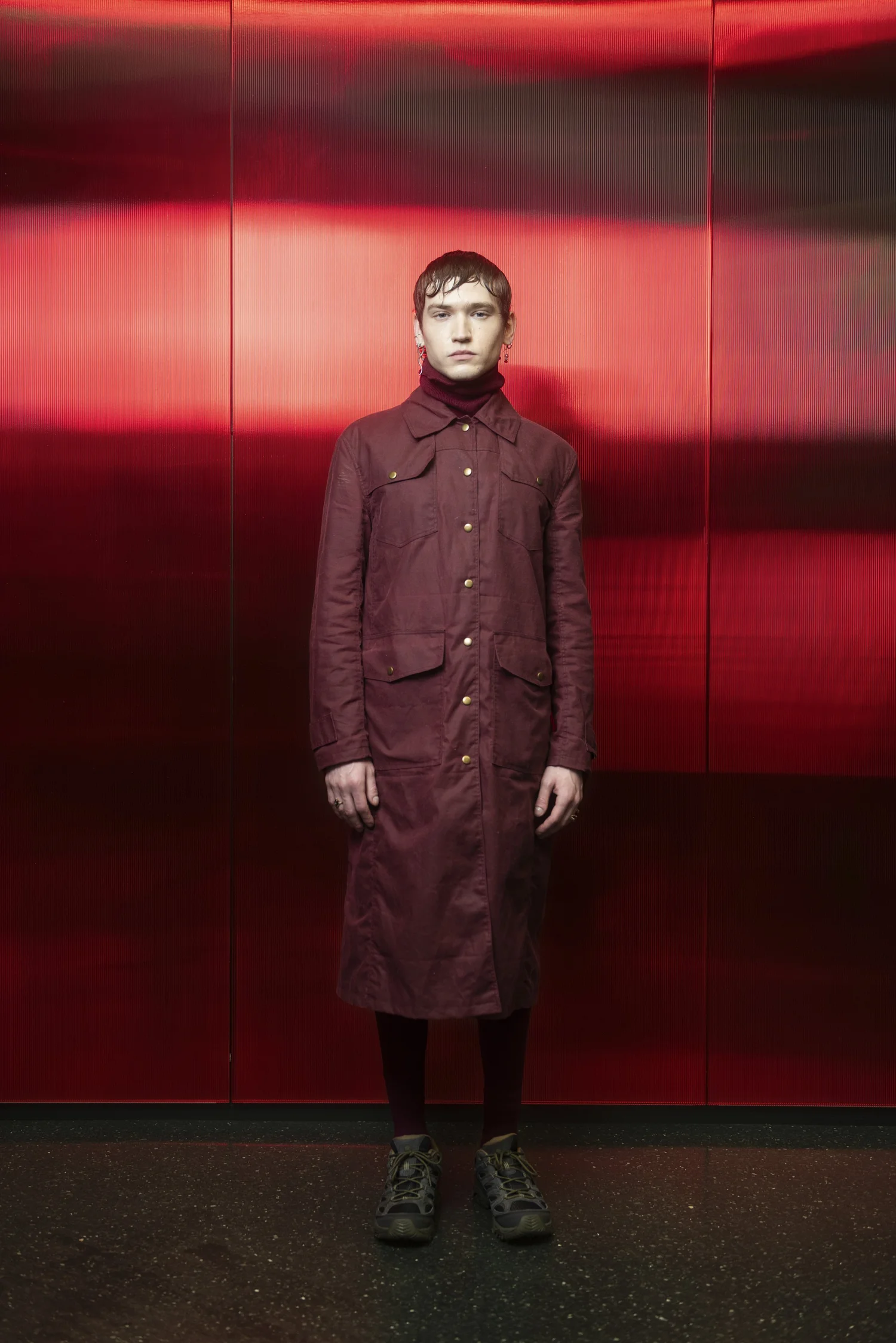
The Bordeaux Cape Blazer merges structured tailoring with a sculptural cape line, while the Autumn Plaid Wool Cape reinterprets heritage wool through a modern silhouette. For those drawn to quieter gravitas, the Midnight Wool Overcoat offers long-line proportion and precise construction. Each is designed with the same conviction: that a garment can carry history, identity and intention into the present. Our earlier essay on tailoring as inheritance considers that conviction from another angle.
What the Archive Asks of Fashion Today
Revisiting an archive is an act of accountability. It asks what has changed and what has not. Black designers today have more visibility than they did in 1980, yet many of the obstacles Talley documented, from limited access to resources to narrow definitions of who belongs in luxury, remain familiar to independent labels.
For CHELSEA GRAYS, the lesson is to keep building the platforms that Talley and Eunice Johnson understood so well: spaces where Black creativity is presented with context, critique and care. Through Brand Connect, our community initiative supporting students and underserved communities, and through Chelsea Grays' work in the classroom, the brand treats fashion as a cultural platform rather than simply a product. The archive reminds us that the story is never only about the clothes. It is about who is invited to tell it.
Frequently asked questions
When did André Leon Talley work at Ebony?
Talley served as Ebony's fashion editor for about a year in the early 1980s, after working at Women's Wear Daily and W and before joining Vogue as fashion news editor in 1983.
Where did André Leon Talley go to college?
He earned a bachelor's degree in French from North Carolina Central University, an HBCU in Durham, in 1970, and a master's degree in French literature from Brown University.
What was the Ebony Fashion Fair?
Directed and produced by Eunice Johnson, the Ebony Fashion Fair was a traveling fashion show that ran from 1958 to 2009, presenting European couture across the United States and raising roughly $55 million for African American charities.
How does CHELSEA GRAYS connect to this history?
CHELSEA GRAYS is a purpose-driven luxury label founded in 2018 by Chelsea Grays, an NCCU alum and educator. The brand's commitment to activism, education and representation reflects the same belief that guided Talley's work at Ebony: that fashion is a form of cultural authorship.
