

For decades, the price of a garment has been treated as a kind of moral shorthand. Pay more, the assumption goes, and you are paying for better conditions, better materials and a better conscience. A new industry report released this week suggests that assumption deserves far closer scrutiny.
The 2026 Ethical Fashion Report, the eleventh edition of Baptist World Aid's long-running assessment, concludes that the fashion industry's ethical and environmental progress has largely stalled. Among its most striking findings is how little separates luxury from fast fashion. For CHELSEA GRAYS, a purpose-driven label founded in 2018 on the conviction that fashion can change the world, the findings are less a headline than a question every brand, and every customer, should be prepared to answer: what exactly does luxury promise?
What the 2026 Ethical Fashion Report Found
Published on October 20, 2026, the report assessed more than 500 brands across measures that include governance, supply chain tracing, supplier relationships, worker empowerment and environmental sustainability. According to coverage by ABC News, the average score was 31.5 out of 100, an improvement of just 0.2 percent since the previous edition in 2024. Ecotextile News reported that living wages and worker empowerment remain the industry's weakest areas.
The gap the report identifies is not primarily one of intention. ABC News reported that 93 percent of companies had policies on workers' rights and sustainability, yet many had little visibility beyond their direct suppliers. Katherine Halliday, who leads the organization's ethical fashion work, told the outlet that companies are improving at setting policies but are "falling short of really implementing those." Only 7 percent of brands earned a perfect score on responsible purchasing practices.
There were signs of movement in materials. The share of brands using sustainable fibres rose to 38 percent from 30 percent in 2024. But the report noted that overall growth in fibre production, particularly petroleum-based synthetics, outweighed those gains. Producing more of a better material is still producing more.
Luxury and Fast Fashion: A Narrower Gap Than Expected
The figure that should give the luxury sector pause is a comparison of averages. ABC News reported that luxury and premium brands averaged 38.63, while fast fashion brands averaged 37.91. The difference is marginal. A higher price, in other words, is not a reliable indicator of how a garment was made or who was paid fairly to make it.
This should not surprise anyone who has studied the industry closely. Prestige has long been built on image, heritage and scarcity rather than transparency. A storied name can sit comfortably alongside a supply chain that its customers will never see. The report's highest score, 70 points, went to Patagonia, an outdoor brand rather than a fashion house, a reminder that accountability is a choice rather than a function of category.
For anyone who buys luxury with the belief that it represents a more responsible way to dress, the lesson is simple. The label on the price tag tells you very little. The questions you ask tell you far more.
Why Policy Without Practice Falls Short
The distance between a written policy and a lived practice is where the industry's credibility is won or lost. A code of conduct can be drafted in an afternoon. Knowing who spun the yarn, who dyed the cloth and who sewed the seams takes sustained effort, relationships and a willingness to be held to account.
The same caution applies to materials. A recycled or natural fibre is meaningful, but it can also become a marketing gesture if it is used to make an ever larger volume of garments designed to be replaced within a season. Sustainability measured only by fibre content misses the more difficult questions of volume, longevity and labor.
This is why CHELSEA GRAYS speaks about responsibility in terms of craft and quantity rather than slogans. As explored in our earlier feature, Waxed Cotton and Hand-Dyeing: The Slow Craft Behind CHELSEA GRAYS, a garment that can be maintained, repaired and kept for years is a garment that stays out of the waste stream far longer than one made to be discarded.
What Luxury Should Mean in 2026
If luxury is to mean anything beyond aesthetics, it must stand for intention. At CHELSEA GRAYS, that intention shows up in the work itself. Hand-felted wool, hand-dyed surfaces and small, considered quantities resist the logic of endless replenishment. Each garment is designed to be worn for years, not weeks.
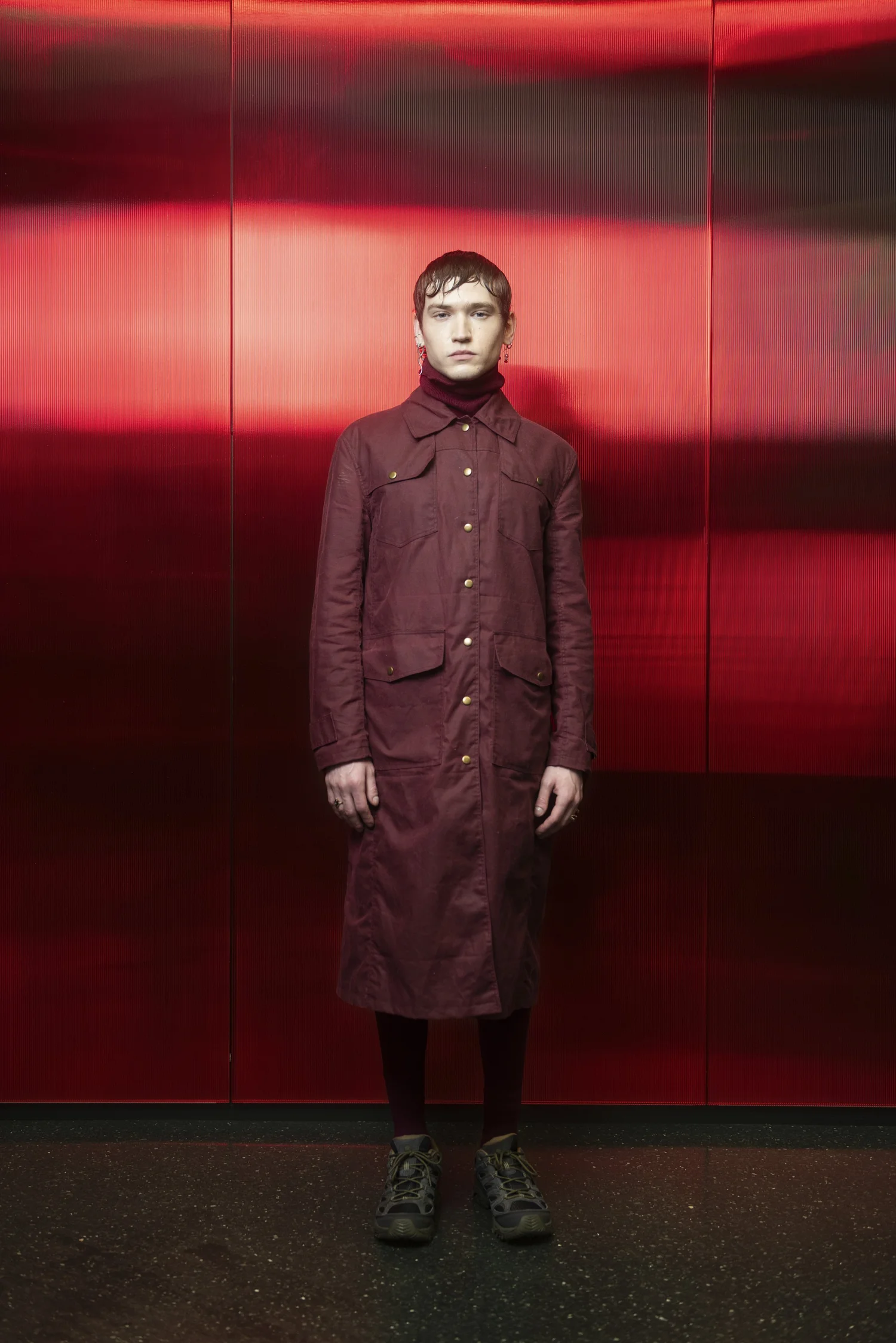
The Felted Wool Blazer reimagines classic tailoring through a deeply textural, hand-worked surface. The Gradient Wool Blazer is offered as a single piece, a reminder that a garment made in a quantity of one cannot be treated as disposable. And the Waxed Cotton Trench Coat belongs to a tradition of workwear built to be re-proofed rather than replaced.

None of this places any brand beyond scrutiny, and it should not. The value of a report like this one is that it asks the entire industry, from the largest conglomerate to the independent studio, to demonstrate rather than declare. Luxury beyond aesthetics is a standard to be earned continually.
How to Shop More Consciously
The report offers consumers a useful set of questions, whatever they choose to buy:
- Ask who made it. Look for brands willing to speak about their makers and processes in specific terms rather than general promises.
- Look past the fibre. A sustainable material matters most when it is used to make fewer, better garments.
- Measure cost per wear. A piece worn for a decade is a different investment than a piece worn for a season.
- Care for what you own. Re-proofing waxed cotton, storing wool properly and repairing rather than replacing are among the most effective choices available.
- Do not let price speak for ethics. As the report shows, a luxury price alone guarantees very little.
Fashion has always been a language. The 2026 Ethical Fashion Report is a reminder that what a garment says about the person who made it matters as much as what it says about the person who wears it. To see how CHELSEA GRAYS translates purpose into design, explore the Fall 2026 collection.
Frequently asked questions
What is the Ethical Fashion Report?
It is a periodic assessment published by Baptist World Aid that scores fashion companies on governance, supply chain tracing, worker empowerment and environmental sustainability. The 2026 edition, released October 20, is the eleventh.
Are luxury brands more ethical than fast fashion brands?
Not necessarily. According to ABC News coverage of the 2026 report, luxury and premium brands averaged 38.63 while fast fashion brands averaged 37.91, a marginal difference.
Is a garment made from sustainable fibres automatically sustainable?
No. The report found that sustainable fibre use rose, but overall growth in production, particularly of synthetics, outweighed those gains. Volume and longevity matter as much as material.
How does CHELSEA GRAYS approach responsible fashion?
CHELSEA GRAYS emphasizes craftsmanship and quality over quantity, using techniques such as hand-felting and hand-dyeing and designing garments to be worn, cared for and kept for years.
